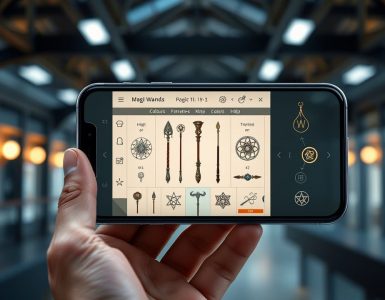

In big software projects, bugs can hide deep — especially when there are many modules, teams, and moving parts. Sometimes, no matter how many logs or tests you run, the bug stays invisible. Sure, tools like static analysis, debuggers, and code reviews help — but they take time and don’t always catch the problem. That’s where an experimental approach like Remote Viewing (RV) can help. It’s been tested in various fields, including military research, and now some developers use it as a tool to guide their debugging process. If you need a little help, we know this remote viewing app is a good starting point. It has 22 trainers and 4 of them are for RV practice. It is not a magical tool, but it definitely sharpens your ESP and when traditional debugging hits a wall, it can save time and point you in the right direction.
What Is Remote Viewing – And How to Remote View Top Hidden Bugs
Developers often describe a “gut feeling” when something in the system feels off. Remote Viewing gives structure to that instinct, helping sharpen pattern recognition and uncover issues that don’t show up in logs or tests. As at its core, RV is the ability to obtain information about a system or environment remotely, without relying on direct sensory input.
Here’s how it works in simple terms. You follow a set protocol — a sequence of steps that help you clear your mind and focus on a specific target. In this case, the target might be “the source of the bug in the login system” or “the part of the code causing the crash”.
You don’t think logically at this stage — you just record impressions: shapes, flows, movements, textures, even emotions tied to the error. These raw perceptions often point you toward the problematic area (e.g., a forgotten dependency or a misconfigured environment).
As for frontloading, it depends. If the project is complex, a little frontloading (e.g., “the bug is likely in the auth module”) can help narrow focus. But too much can bias the result and push you to guess, not sense.
5 Bugs That Waste the Most Time
Below are five common types of software bugs that should be prioritized during debugging:
- Security Bugs
These are the ones you really don’t want to miss. Sometimes it’s a tiny thing — a logic slip, a bad check, or something left open — and next thing you know, someone’s poking around your system. Once a hole like that gets out, it can spiral fast. - Compatibility Bugs
Everything works great on your machine… until someone opens it on a different phone or browser and nothing loads right. These bugs are frustrating because they often slip through in testing — especially when you don’t have access to every possible device combo. - Functionality Bugs
This is the basic stuff that just doesn’t work. You click a button and nothing happens, or worse, the core feature crashes. Whether it’s something small or mission-critical, it’s always annoying for users and usually ends up in a 1-star review. - Syntax Errors
The easiest to fix but still the ones that break everything. A missing bracket, a typo, a forgotten comma — and boom, your whole app fails to compile. Usually caught early, but they still eat up time when you’re in a rush. - Logic Errors
These are sneaky. The app runs, tests pass, but something feels off. Maybe the totals are wrong, or it’s using yesterday’s data. It’s not that the code is broken — it’s just not doing what it should, and that’s a harder thing to spot.
Can You Trust Remote Viewing Results?

So, RV isn’t just some sci-fi idea — it’s been tested in some pretty serious government projects. Take Project Stargate, for example. This was a CIA-backed program in the ’70s and ’80s where trained remote viewers tried to collect intel on secret Soviet sites. One famous case involved a guy named Pat Price. Without any prior info, he described a secret nuclear testing facility in incredible detail — later confirmed by classified satellite photos.
Then there’s Joe McMoneagle, another remote viewer from the same program. He reportedly helped locate a crashed Soviet bomber in Africa and even predicted a hostage release in the Middle East, including details about the hostage’s health. He also pinpointed where a kidnapped American general was being held — down to the exact apartment floor.
Remote viewing has even been used to help in missing person cases. For instance, a remote viewer named Angela Thompson Smith helped provide clues that matched the identification of a body found near Catalina Island. Another remote viewer, Major Ed Dames, claims he helped locate the remains of a missing toddler in France.
Of course, it isn’t perfect or accepted everywhere — it’s more like a tool that can sometimes offer surprising leads. But these examples show that, when combined with other methods, it can be pretty powerful.
Bottom Line
Software bugs cost the global economy somewhere between $2 and $2.4 trillion in 2022. That’s a massive number — and it shows why even the small bugs matter. One glitch can seriously mess things up and stop a business in its tracks. So saving time on tracking and fixing issues isn’t just about writing better code — it’s about keeping things running. That’s why it makes sense to not only rely on standard debugging tools but also consider new ideas, like remote viewing, to catch problems faster.