
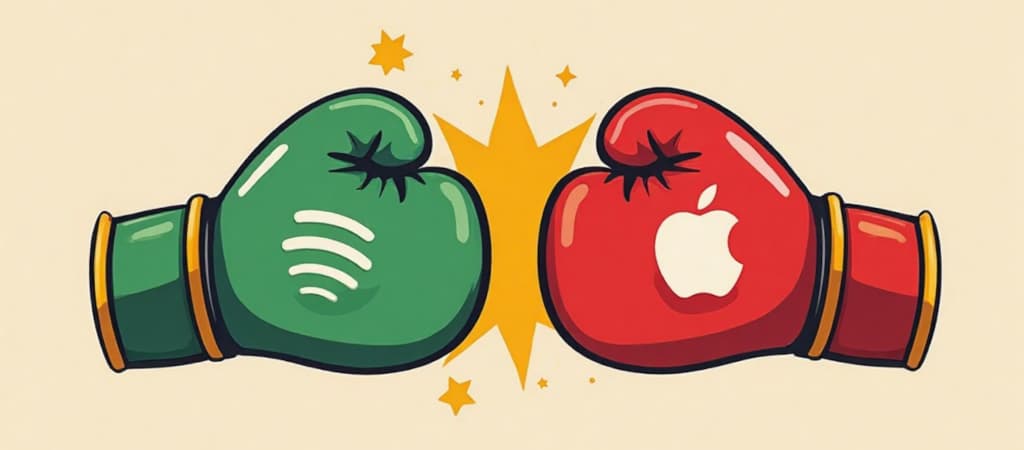
In 2024, the European Commission hit Apple with a historic €1.8 billion fine for anti-competitive App Store practices — a direct result of Spotify’s long-standing battle against anti-steering rules. For iOS developers, this wasn’t just regulatory theater — it marked a rare and powerful win for platform accountability.
Apple can no longer prohibit EU-based apps from directing users to external payment options. For years, developers were stuck with Apple’s 15–30% cut and couldn’t even link to better deals off-platform. That era is officially ending — at least in Europe. While the fine itself won’t bankrupt Apple, the policy shift it triggers may reshape the global App Store playbook.
If you’ve ever felt boxed in by Apple’s closed ecosystem, this ruling cracks open a door. Smart developers should already be walking through it.
How Spotify Took on Apple — and Won
This was a multi-year war of attrition. Spotify, one of Europe’s tech giants, accused Apple of stifling innovation by limiting user choice and charging punishing fees. Apple’s rules didn’t just raise costs — they blocked Spotify from even telling users there was a cheaper subscription on its website.
What started as a regulatory complaint in 2019 evolved into a full-blown EU investigation — and now, a landmark decision. Spotify didn’t just win for itself. It cracked open Apple’s walled garden for every developer in the EU.
Daniel Ek, Spotify’s CEO, called it “a victory for consumer freedom and developer fairness”. It’s also a template for how regulation can re-balance power in digital marketplaces. The message: even the most entrenched gatekeepers aren’t untouchable.
Apple Answer
Apple pushed back on the ruling, arguing that the European Commission failed to demonstrate real consumer harm and overlooked the competitive nature of the app economy. In a public statement, the company insisted that “developers compete on a level playing field” within the App Store and that the marketplace remains vibrant, fair, and fast-growing.
What This Means for the Future of the App Store
This ruling is more than a European issue. It’s the first domino. Korea, Japan, and even parts of the U.S. are watching closely — and in some cases, already drafting similar legislation. Apple knows it. You should, too.
If enough markets force Apple to allow external payments and competitive pricing flows, the App Store’s business model could shift from a tollbooth to a service platform. That changes everything — for monetization, user acquisition, and LTV strategies.
More importantly, it signals that platform policies can — and will — be shaped by developer pressure, public opinion, and regulation. This isn’t the last time Apple will have to bend.
Global Implications: A Ripple Effect Beyond Europe
While the EU’s decision directly impacts European markets, its influence is global. Countries like Australia are considering similar regulations to promote competition and reduce monopolistic practices in digital marketplaces . Developers worldwide should anticipate and prepare for a future where alternative app distribution and payment methods become standard. Also, Apple updated App Store guidelines for U.S. markets.
Here’s what’s newly allowed in the USA:
- Link to your own checkout experience via Stripe, Shopify, Paddle
- Avoid Apple’s 15–30% platform fees
- A/B test pricing models directly in the app
- Design branded, high-conversion purchase flows
- Align payments across mobile, web, CRM, and lifecycle tools
- Use AI for dynamic pricing and churn prediction
Apple’s Official Guideline Updates (May 2025): What Every Mobile Product Owner Needs to Know
Apple’s response to the EU’s Digital Markets Act (DMA) includes significant changes:
- Alternative Payment Options: Developers can now direct EU users to external payment systems, bypassing Apple’s in-app purchase mechanism .
- Reduced Commissions: Apple has introduced a reduced commission structure — 10% for most developers and 17% for others, with an additional 3% fee if using Apple’s payment processing .
- Core Technology Fee (CTF): A new €0.50 fee applies for each first annual install per year over a 1 million threshold, impacting high-volume apps .
These changes are currently limited to the EU.
Actionable Strategies for Developers
To leverage these developments:
- Implement External Payment Links: Utilize the newfound ability to guide users to external payment platforms, potentially increasing revenue by avoiding Apple’s commission fees.
- Optimize Pricing Models: Experiment with different pricing strategies outside the App Store to determine what resonates best with your audience.
- Enhance User Experience: Design seamless transitions to external payment systems to maintain user trust and satisfaction.
Final Takeaway
The Apple ecosystem is no longer bulletproof. The EU’s fine is a rare case of real enforcement against platform overreach — and for developers, it’s a tactical green light. Whether you’re a solo indie dev or running a product org, the implications are clear:
- You’ll have more control over your business model
- You can finally stop bleeding margin to mandatory platform fees
- You now compete in a more level playing field (at least in Europe)